
When you’re building a house, the steel going into your foundation, columns and slabs matters as much as the cement holding it all together. Most homeowners spend weeks comparing tile brands or bathroom fittings, then rush the steel decision because it feels too technical. That’s a costly habit, since TMT bars are what keep a house standing through heavy monsoons, shifting soil and decades of daily use.
This guide covers what actually matters when picking the best TMT bar for house construction, so you can talk to your contractor and supplier with confidence instead of trusting whatever gets suggested on site.
Why TMT Bars Matter in House Construction
TMT stands for Thermo-Mechanically Treated steel. The bars are cooled rapidly on the outer surface while the core stays hot, creating a hard outer layer with a softer, ductile core, giving the bar strength along with the ability to bend under stress instead of snapping.
In a residential building, TMT bars go into the foundation, columns, beams and roof slab. Weak or substandard bars in any of these areas can cause cracked walls, sagging slabs, or serious structural issues later. Since reinforcement steel sits buried inside concrete, poor quality is almost impossible to catch once the building is up. Mangla Steels’ TMT bar range is worth checking before finalising quantities with your engineer.
Which TMT Grade Is Best for a House?
There isn’t one grade that suits every home. Choosing the best TMT for house construction depends on the number of floors, soil condition, seismic zone, and the load your structural engineer has worked out for your specific plan.
That said, most independent homes and mid-rise buildings today use Fe 500 or Fe 500D grade bars, since both balance strength and flexibility well for typical residential loads. Fe 415 still shows up on older or smaller structures, but higher grades have largely taken over.
Never lock in a grade yourself or on a shopkeeper’s suggestion. This guide to choosing the right TMT grade explains how engineers arrive at that decision.
Fe 500 vs Fe 500D
Homeowners often get stuck comparing these two:
- Fe 500 offers high strength and is commonly used across standard residential and commercial construction.
- Fe 500D has the same strength rating but with added ductility and lower carbon content, so it performs better under seismic movement and sudden stress.
Fe 500D suits earthquake-prone zones or taller structures better, while Fe 500 works fine for many standard homes. This isn’t a call to make yourself: your engineer’s design specifies which your house needs, and it should be followed exactly, not swapped for something “similar” to save money.
What to Check Before Buying TMT Bars
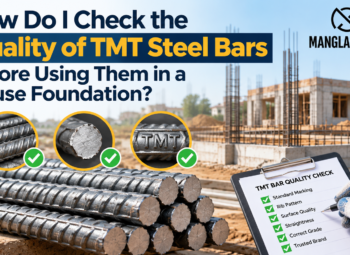
A genuine bar isn’t just about the name printed on it. Before you order, check for:
- BIS/ISI certification confirming the bars meet IS 1786 standards
- Mill test certificate (MTC) for the specific batch, not a generic claim
- Even rib pattern, since shallow or uneven ribs point to poor rolling
- Weight consistency against standard theoretical weight
- A bend test on site, since genuine bars bend without cracking
Buying purely on a brand sticker without these documents is a common mistake.
How Much TMT Steel Does a House Need?
There’s no fixed number, since quantity depends on built-up area, floors, and your engineer’s design. As a rough reference, small independent houses often use around 4 to 5 kg of steel per square foot, though this shifts with soil bearing capacity and planned floors. The reliable way to know your actual requirement is through a Bar Bending Schedule (BBS), which lists the exact length, diameter, shape and quantity of every bar, cutting wastage and giving you a firm figure to quote against.
Why Price Should Not Be the Only Factor
It’s tempting to pick whichever quote is lowest, but bars priced noticeably below market rate usually mean a compromise, whether that’s understated weight, weaker composition, or missing certification. Rates move with raw material costs too, so it helps to understand what actually affects TMT bar pricing before comparing quotes.
Look beyond the per-kg rate: is it for the exact grade and size in your BBS, does it include a mill test certificate, is delivery included, and what’s the supplier’s track record for your quantity?
Why Local Supply Matters in Punjab
Concrete pours are scheduled around weather and site readiness, and a delayed delivery can push back an entire phase of work. A Punjab-based supplier means shorter delivery times and someone who understands local conditions. See this guide on choosing the right steel supplier for what separates a dependable one from a risky one.
Practical TMT Buying Checklist
- Confirm grade and sizes match your engineer’s drawings
- Ask for certification and the batch’s mill test certificate
- Get the Bar Bending Schedule prepared before ordering
- Compare at least two or three quotations, not one
- Confirm delivery timelines in writing
Why Choose Mangla Steels
We supply TMT bars and construction steel across Punjab as an authorised dealer, not a manufacturer, so every batch carries traceable certification rather than an unverifiable local claim. For homeowners sourcing the best TMT for house construction, that documentation, along with competitive pricing and dependable delivery, makes the difference on site.
Frequently Asked Questions
Q: Which TMT bar is best for house construction?
A: No universal answer exists. Most homes use Fe 500 or Fe 500D depending on structural design and load. The right choice for the best TMT for house construction always comes from your approved drawings.
Q: Is Fe 500D better than Fe 500?
A: Not better, just different. Fe 500D suits earthquake-sensitive areas or taller buildings with its higher ductility, while Fe 500 works well for many standard homes. Your engineer’s design decides which applies to you.
Q: What TMT bar sizes are commonly used in houses?
A: Typically 8mm and 10mm for slabs, and 12mm, 16mm or 20mm for columns, beams and foundations, depending on load. The exact combination should follow your Bar Bending Schedule.
Q: How can I check whether TMT bars are genuine?
A: Look for the BIS/ISI mark, ask for a mill test certificate, check that the rib pattern is even, and confirm the weight matches standard theoretical weight. It should pass a basic bend test without cracking.
Q: How much TMT steel is required for a house?
A: It varies by built-up area, floors and design. A rough reference for small homes is 4 to 5 kg per square foot, but the accurate figure comes only from a Bar Bending Schedule.
Q: Should I choose TMT bars based only on price?
A: No. Unusually low prices often mean compromised weight, grade or missing certification. Weigh certification, delivery reliability and track record along with price.
Final Takeaway
Choosing steel for your house isn’t a decision to rush or hand to whoever quotes the lowest price. Confirm grade and quantity through your structural engineer, insist on certification, and work with a supplier who backs material with documentation and reliable delivery. That’s the real starting point for the best TMT for house construction, backed by our quality standards and a verifiable dealership.
If you’re finalising your steel requirement, get in touch with Mangla Steels and share your Bar Bending Schedule for an accurate quote.