
If you are building a house, the foundation is not the place to take chances. And a big part of a strong foundation comes down to one thing buyers often overlook: the quality of the TMT bars going into it.
Most homeowners and first-time builders don’t know what to look for when the delivery truck arrives. You see a bundle of steel rods, they look fine on the surface, and you sign off on it. But TMT bar quality isn’t something you can fully judge with a glance. If you’ve been searching for how to check TMT bar quality before it gets buried under concrete, this guide walks you through exactly what to inspect, what documents to ask for, and what mistakes to avoid.
Why TMT Bar Quality Matters in a House Foundation
The foundation carries the entire weight of your house, and it’s the reinforcement steel inside the concrete that gives it the strength to resist load, movement, and even seismic activity. Poor quality TMT bars can mean weaker load-bearing capacity, faster corrosion inside the concrete, and structural problems that are extremely expensive to fix once construction is complete.
Unlike a wall crack you can patch later, a foundation problem is often hidden for years before it shows up. That’s exactly why a proper TMT bar quality check at the buying stage matters so much more than people realise.
How to Check TMT Bar Quality Before Buying
Here’s a step-by-step look at what actually goes into a good quality check.
Check the Grade and Required Specifications
Before you even think about brands or pricing, go back to your structural engineer’s drawing. The grade of steel (Fe 500, Fe 500D, Fe 550, Fe 550D, etc.), the diameter, and the quantity should all come from the structural design, not from what looks good at the shop or what fits the budget. Buying a lower grade than specified to save money is one of the most common and most risky shortcuts people take.
Look for BIS/ISI Markings
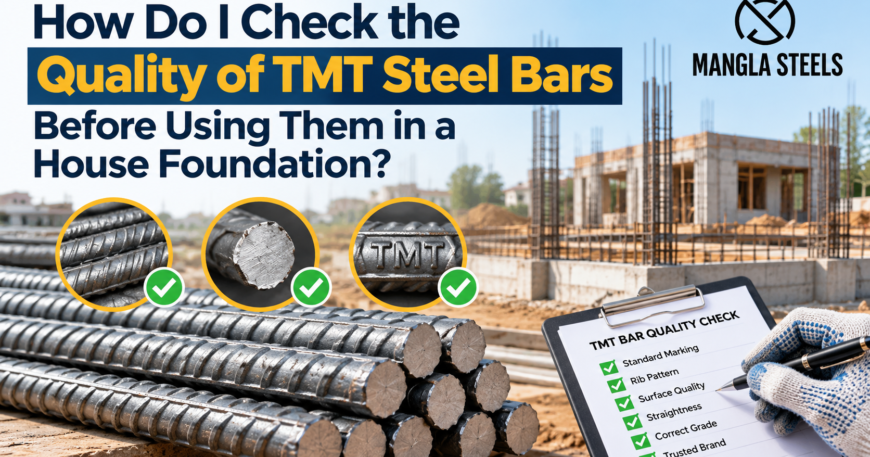
Every genuine TMT bar sold in India should carry BIS (Bureau of Indian Standards) markings as per IS 1786. Check for the ISI mark, the manufacturer’s identification, and the grade stamped along the length of the bar. If these markings are missing, faded beyond recognition, or look inconsistent across the bundle, that’s a red flag worth asking about before you accept the delivery.
Inspect the Surface and Rib Pattern
Run your hand along a few bars and look closely at the rib pattern (the raised ridges on the surface). These ribs aren’t decorative; they help the bar bond properly with concrete. Uneven ribs, patchy sections, or a rough, inconsistent surface can point to inconsistent manufacturing.
Check Diameter and Weight
Every diameter of TMT bar has a standard theoretical weight per metre, published by manufacturers and available online. If the bars feel noticeably lighter than they should for their stated diameter, that’s often a sign of underweight steel, meaning you’re getting less material than you’re paying for and possibly weaker structural performance. A simple check with a tape and a weighing scale on a sample length can save you a lot of trouble later.
Look for Excessive Rust, Cracks or Visible Damage
A light surface coating of rust on TMT bars is fairly normal and doesn’t necessarily mean poor quality; it often happens during storage or transport. But flaky, deep rust, visible cracks, bends, or pitting on the surface are different matters. These can weaken the bar’s structural performance and shouldn’t be ignored just because the price was attractive.
Ask for the Mill Test Certificate
A Mill Test Certificate (MTC) is one of the most important documents in TMT bars for house foundation work, and yet it’s the one most homeowners never think to ask for. The MTC gives you the chemical composition and mechanical properties of that specific batch, things like carbon content, tensile strength, and yield strength, tested at the manufacturing stage. Always request this before or at the time of delivery, and keep it on file along with your other construction records.
Verify the Manufacturer and Batch Details
Cross-check the brand name on the bar against the invoice and the MTC. Genuine suppliers will be able to trace a batch back to its manufacturing date and mill. If a supplier can’t answer basic questions about where the batch came from, treat that as a warning sign.
Can You Check TMT Bar Quality by Appearance Alone?
Here’s something worth being honest about: you cannot confirm TMT bar quality just by looking at it. Visual inspection tells you about surface condition, markings, rib pattern, and obvious defects, but it says nothing about the internal chemical composition or the actual tensile and yield strength of the steel.
Two bars can look identical on the outside and perform very differently under load. That’s why relying only on visual checks is risky, and why documentation like the Mill Test Certificate matters as much as, if not more than, what your eyes can tell you. For larger projects, or when there’s any doubt about a supplier’s documentation, independent material testing at an accredited lab is a reasonable extra step, especially for structures that need to meet strict engineering tolerances.
TMT Bar Quality Checklist Before Accepting Delivery
Keep this handy the next time a delivery arrives:
- Grade and diameter match your structural drawing/BBS
- BIS/ISI mark and manufacturer ID clearly visible
- Rib pattern is even and consistent across bars
- Weight matches the standard for the stated diameter
- No excessive rust, cracks, bends, or pitting
- Mill Test Certificate provided for the batch
- Batch and manufacturing details are traceable
- Invoice matches the brand and grade actually delivered
Common Mistakes to Avoid When Buying TMT Bars
A few mistakes come up again and again during house construction:
- Choosing a lower grade than what the structural engineer specified, just to cut cost
- Judging quality purely by how shiny or clean the bars look
- Not asking for a Mill Test Certificate at all
- Buying from a supplier who can’t explain where the batch came from
- Assuming “cheaper per kg” always means better value, without checking documentation
- Skipping a basic weight and diameter check on delivery
Most of these mistakes aren’t about being careless; they happen simply because nobody explained what to check in the first place.
How to Choose a Reliable TMT Steel Supplier
Once you know what good TMT bar quality looks like, the next question is who to buy from. A reliable supplier should be able to offer:
- The exact grade and diameter your project needs, without pushing substitutes
- Proper BIS certification and batch documentation on request
- Material traceability back to the manufacturer
- Consistent stock so your project isn’t delayed waiting for material
- Accurate quantities, verified against invoices
- Reliable, on-time delivery to site
- Transparent, upfront pricing with no hidden surprises
This is also where working with an established name helps. Mangla Steels has built its reputation on supplying certified, traceable TMT bars for residential and commercial projects, and buyers are always encouraged to ask for grade certificates and batch details before finalising an order, not just taking a supplier’s word for it.
If you’re still working out which TMT bars for house construction fit your project’s structural requirements, it helps to go over your BBS with your supplier before placing the order rather than after.
Sourcing and Documentation Matter as Much as the Steel Itself
Good TMT bar quality checks don’t end at the site gate. Where and how you source your material plays a big role too. Ask your supplier for TMT bar quality and certification documents as a standard part of every order, not as a special request. A supplier who maintains proper batch records and shares them without hesitation is usually one you can trust for the next order too. Mangla Steels follows this practice with every dispatch, keeping certification and batch traceability tied to each delivery.
For a broader look at what to verify before any steel purchase, not just TMT bars, this guide on what to check before ordering steel for your construction site is worth a read.
Conclusion
Checking TMT bar quality isn’t complicated once you know what to look for, grade and specification, BIS markings, rib pattern, weight, visible defects, and above all, the Mill Test Certificate. None of these checks take long, but skipping them can cost you far more down the line, especially in something as critical as a house foundation.
Whether you’re sourcing steel yourself or working through a contractor, insist on documentation and don’t rely on appearance alone. Mangla Steels supplies certified TMT bars with full batch traceability for homeowners and builders across the region, and is always happy to walk buyers through grade selection and certification before an order is placed.
FAQs About TMT Bar Quality
Q: How can I check whether a TMT bar is good quality?
A: Look at the BIS/ISI marking, rib pattern, diameter and weight, and check for visible defects like cracks or heavy rust. But for full confirmation, always ask for the Mill Test Certificate, since visual checks alone can’t confirm the steel’s actual strength.
Q: What markings should I check on a TMT bar?
A: Look for the BIS/ISI mark, the manufacturer’s brand identification, and the grade (such as Fe 500D) stamped along the bar’s length. These should be clear and consistent across the entire batch.
Q: How do I check TMT bar weight and diameter?
A: Measure the diameter with a tape or gauge and weigh a sample length. Compare this against the manufacturer’s published theoretical weight for that diameter. A noticeable shortfall usually points to underweight or substandard bars.
Q: Is some surface rust on TMT bars acceptable?
A: Light surface rust from storage or transport is generally not a concern and doesn’t affect structural performance. Deep, flaky rust, pitting, or corrosion that’s eaten into the bar’s surface is a different issue and should be flagged.
Q: Can I choose the TMT grade myself for my house foundation?
A: It’s best not to. Grade, diameter, and quantity should follow your structural engineer’s drawing or BBS, since these are calculated based on your building’s load requirements, not personal preference or budget alone.