
Introduction
A steel order is one of those decisions that either saves you money for the next thirty years or costs you money for the next thirty years. There is rarely an in-between. Once TMT bars are cast into a slab or a column, nobody is pulling them out to check the mill certificate. That is exactly why buyers who have been through a few projects treat a steel purchase differently than any other line item on the estimate. At Mangla Steels, the Trusted TMT Bars supplier in Ludhiana, conversations with first-time builders and seasoned contractors alike tend to circle back to the same worry: how do you know the steel you are paying for is actually the steel you are getting? This blog walks through how experienced buyers answer that question, step by step, before a single rupee changes hands.
Why Buying the Right Steel Matters More Than People Think
Most construction failures related to steel are not dramatic collapses. They show up years later as cracked plaster over corroding rebar, sagging roof sheets, or a fabricated gate that starts rusting from the inside within eighteen months. The damage is slow, quiet, and expensive to fix because by the time it is visible, the steel is already embedded in concrete or welded into a structure.
Buyers who have been burned once tend to develop a habit: they stop trusting the invoice and start trusting the physical material and the paperwork behind it. That shift in mindset is really the whole point of this guide. Quality construction steel is not something you can eyeball from a delivery truck. It is something you verify through a combination of documentation, testing, and knowing which questions make a supplier uncomfortable.
Types of Construction Steel and Where Each One Actually Belongs
A lot of buying mistakes happen simply because someone orders the wrong category of steel for the job, not necessarily bad steel. Here is how the main categories break down on an actual site.
TMT Bars carry the load in every reinforced concrete structure. Foundations, columns, beams, and slabs all depend on them, and this is the one product where grade (Fe 500, Fe 500D, Fe 550D) genuinely changes how the structure behaves under seismic stress. If you are pouring a footing tomorrow, this is the TMT bars page worth reviewing before you finalize quantities.
MS Angles show up in trusses, gates, staircases, and support framing. Their strength comes from the L-shaped cross section, so thickness consistency along the length matters more than most buyers realize. A supplier who can walk you through MS angles specifications by thickness and size is usually one who actually stocks a range rather than whatever happens to be sitting in the yard.
MS Channels get used wherever a rigid horizontal or vertical member is needed without the bulk of a full beam, think purlins, door frames, or machine bases. Buyers often confuse channel sizing with beam sizing, which is a mistake that gets expensive once fabrication starts.
MS Beams (ISMB) are the backbone of larger structural spans, industrial sheds, and mezzanine floors. This is not a category to shop on price alone. A beam that is even slightly under the rated section weight will deflect more than the design allows, and you will not notice until the structure is loaded.
MS Pipes and MS Square Pipes cover everything from plumbing and fencing to structural columns in light industrial buildings. Wall thickness is the number that actually determines strength here, not outer diameter, which is the detail most suppliers gloss over unless you ask directly.
GP/GC Sheets, GI Sheets, CR Sheets, and HR Sheets handle roofing, cladding, and fabrication work. Coating weight (GSM) on galvanized sheets is what determines how long they resist rust in Punjab’s humid monsoon months, and it is printed on the mill test certificate, not on the sheet itself.
MS Plates and Flat Bars round out most fabrication and base-plate work, and their thickness tolerance is one of the easiest things to verify with a simple vernier caliper on delivery.
Knowing which category your project actually needs, and roughly how much of it, is the first filter that prevents overordering, underordering, and paying for a grade of steel your structure does not require.
How Experienced Buyers Actually Evaluate Steel Quality
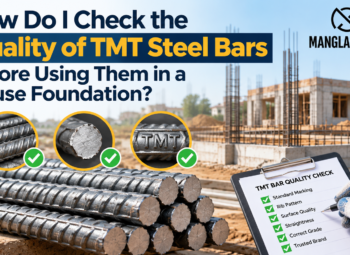
Ask any site engineer who has been doing this for a decade what they check first, and it is rarely the price. It is the surface. Genuine TMT bars have consistent, sharp ribbing along the entire length. Counterfeit or reprocessed bars often show uneven ribs, patchy surface texture, or slight bends that indicate the bar was rolled from scrap rather than proper billets.
The next check is weight. Steel has a known theoretical weight per meter based on diameter. A 12mm TMT bar has a fairly fixed weight range, and if a bundle comes in noticeably lighter, that is not a coincidence, it usually means the actual diameter is undersized even though it is labeled correctly. Experienced buyers carry this number in their head or on their phone and do a spot check on delivery, not after the truck has left.
Bend and rebend testing matters more for TMT than most buyers expect. A genuine Fe 500D bar should bend around a mandrel without surface cracking. If a sample cracks on a simple 180-degree bend test, that bar has no business going into a seismic zone structure, and Punjab does see occasional seismic activity that codes account for.
For sheets and plates, thickness consistency across the surface, not just at the edge, is the detail that separates a properly rolled sheet from one with rolling defects. A supplier who invites you to check thickness at multiple points rather than just handing you a spec sheet is usually confident in what they are selling.
Certifications and Standards Worth Actually Verifying
This is the section most buyers skip, and it is the one that protects you legally and structurally if something goes wrong later.
Every batch of genuine TMT bars should come with a mill test certificate (MTC) showing chemical composition and mechanical properties, tested against IS 1786 for TMT bars. Ask for this before payment, not after delivery. A supplier who cannot produce it for a specific batch, not a generic sample certificate from months ago, is a red flag regardless of how good the price looks.
BIS certification (ISI mark) is mandatory for TMT bars sold in India, and it should be visibly embossed on the bar itself, not just claimed verbally. You can cross-check a BIS license number against the BIS website in under two minutes, and that two minutes has saved buyers from six-figure losses.
For structural sections like MS beams and channels, IS 2062 governs the grade of structural steel, and the mill certificate should reference this standard along with the yield strength and tensile strength achieved.
Galvanized sheets should specify coating class under IS 277, since this number directly tells you how many grams of zinc coating per square meter you are actually paying for, which is the entire reason galvanized sheet costs more than plain sheet in the first place.
Keep copies of every certificate for the duration of the project and beyond. If a structural issue surfaces years later, these documents are what protect the buyer, the contractor, and the supplier relationship all at once.
How to Compare Suppliers Without Getting Lost in Quotations
Most buyers compare suppliers on price per kilogram or price per piece, which is exactly how low-quality steel wins bids. A smarter comparison looks at four things side by side: brand and mill source, certification availability for the specific batch being quoted, delivery and storage practices, and after-sale accountability if a batch fails testing.
Ask each supplier the same set of pointed questions. Which mill does this steel come from? Can I get the MTC before I pay, not after? What happens if I test a sample and it fails to meet the stated grade? A supplier who answers all three without hesitation is telling you something about how they run their business. A supplier who gets vague or redirects to “don’t worry, it’s genuine” is telling you something too.
It also helps to visit the yard once, even for a small order. How steel is stored says a lot about how it is handled. Bars stacked directly on wet ground rust faster and lose surface quality before they even reach your site. Sheets stored without proper stacking spacers develop pressure marks. A yard that takes storage seriously usually takes sourcing seriously too, which is one of the operating standards behind how Mangla Steels approaches inventory for contractors across Punjab.
Pricing vs. Quality: Where the Real Trade-off Actually Sits
Here is the uncomfortable truth about steel pricing: genuine, BIS-certified, properly tested steel from a known mill will almost never be the cheapest quote you receive. If one quotation is significantly below the others for the same stated grade and brand, that gap has to come from somewhere, and it is usually one of three places: understated weight, a lower actual grade than labeled, or steel sourced from unaccounted or reprocessed scrap.
That does not mean the most expensive quote is automatically the safest either. Some suppliers price in a premium simply because they can, not because the steel is meaningfully better. The practical approach experienced buyers use is comparing quotes only after normalizing for brand, grade, and certification, then treating price as the deciding factor among options that are already verified equal in quality. Price comparison before quality verification is how most bad steel purchases happen in the first place.
Common Mistakes Buyers Make Before Placing an Order
Ordering by weight alone without confirming diameter tolerance is one of the most frequent errors, since two bars of the same stated weight can have different actual load-bearing diameters if one is underweight per meter.
Trusting a verbal brand claim without checking the embossing or requesting a certificate is another. Verbal assurances do not hold up if there is ever a dispute.
Placing a bulk order without a test sample is a mistake buyers usually make exactly once. A small sample tested by an independent lab before the full order is a fraction of the cost of discovering a problem after the concrete has set.
Ignoring storage conditions between delivery and use is often overlooked too. Steel left exposed to rain for weeks before use can develop surface rust that, while sometimes cosmetic, sometimes indicates deeper pitting that affects bond strength with concrete.
Finally, choosing a supplier purely on proximity or convenience without checking their certification track record is a habit that works fine until the one time it does not.
Professional Buying Checklist Before You Place an Order
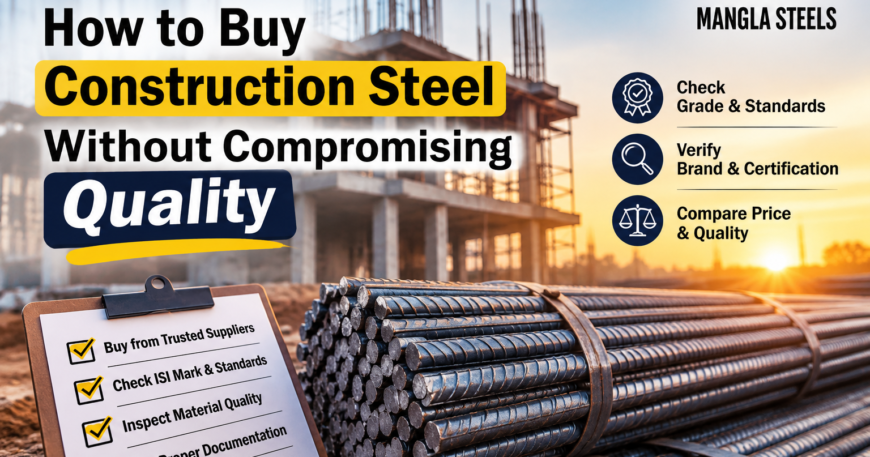
- Confirm the exact steel category and grade needed for your specific structural element
- Request the mill test certificate for the actual batch being supplied, not a generic sample
- Verify BIS/ISI marking is physically present, and cross-check the license number
- Ask for coating class (GSM) documentation on any galvanized product
- Confirm actual weight per meter or per piece against theoretical standard weight
- Request a small sample for independent lab testing on large orders
- Visit or ask about the supplier’s storage and handling practices
- Get quotations from at least three suppliers, normalized for identical grade and brand
- Clarify return or replacement terms in writing if a batch fails testing
- Confirm delivery timeline and site access requirements in advance
Why Buyers Across Punjab Choose Mangla Steels
Contractors and homeowners who work with Mangla Steels consistently mention the same reasons when asked why they came back for a second or third order: certified stock they can actually verify on request, straight answers to direct questions about grade and mill source, and a yard that stores material the way it should be stored rather than however is most convenient. For a state where construction activity runs year-round and margins matter on every project, that kind of consistency tends to matter more than a marginally lower quote from an unfamiliar source.
Frequently Asked Questions From Buyers
- How can I verify construction steel quality before making payment?
A: Ask for the mill test certificate matching the specific batch being delivered, check for BIS/ISI embossing on the material itself, and if the order size justifies it, get a small sample tested independently before confirming full payment. Suppliers confident in their stock rarely hesitate on any of these three requests. - What documents should I request from a steel supplier?
A: At minimum, request the mill test certificate, the BIS license number for TMT bars, and a delivery challan that matches the invoiced quantity and grade exactly. Keep these on file for the life of the project, since they matter far more after construction than during it. - Which steel products are essential for a residential house versus a commercial building?
A: A residential house typically needs TMT bars for the RCC frame, MS pipes for plumbing rough-in, and MS angles or channels for gates, grills, and staircases. Commercial and industrial buildings add structural beams, larger diameter pipes, and often galvanized sheets for roofing spans that residential construction rarely requires. - Is buying steel in bulk always more cost-effective?
A: Not automatically. Bulk pricing helps when the project timeline and storage capacity can absorb it without exposing material to weathering or damage before use. Buying more than you can use within a reasonable window often costs more in handling losses and rust than it saves per kilogram. - How can I calculate the right quantity of steel to avoid wastage?
A: Work from the structural drawing’s bar bending schedule rather than a rough area-based estimate, and add a realistic wastage allowance of five to eight percent for cutting and bending losses. Ordering without a BBS is one of the most common causes of both shortages mid-project and unused surplus at the end. - When is the best time to purchase construction steel for large projects?
A: Prices tend to move with monsoon-season transport disruptions and pre-budget demand spikes, so locking in supply agreements ahead of these periods protects both price and availability. For phased projects, staggering delivery in line with the construction schedule avoids long on-site storage risk.
Final Buying Advice
Buying construction steel well is less about finding the lowest price and more about removing every point where uncertainty could creep into your structure. Verify before you pay, document everything, and treat a supplier’s willingness to answer direct questions as part of the product itself. If you are finalizing quantities or comparing grades for an upcoming order, Mangla Steels is a straightforward call away for certified stock and honest guidance on exactly what your project needs.